AI for Research: My Conversation with Ateneo de Naga University on Research Integrity
I joined Ateneo de Naga University to discuss generative AI in research, academic integrity, human accountability, and responsible AI-assisted writing.
Generative artificial intelligence has become a familiar companion in academic research. From brainstorming research questions and reviewing literature to polishing manuscripts and interpreting information, AI tools are increasingly finding their way into researchers' everyday workflows. Some researchers welcome the convenience, while others remain understandably cautious about what these technologies might mean for academic integrity.
But perhaps the more important question is not whether researchers should use generative AI. It is whether we can use these tools without compromising the very principles that make research trustworthy in the first place.
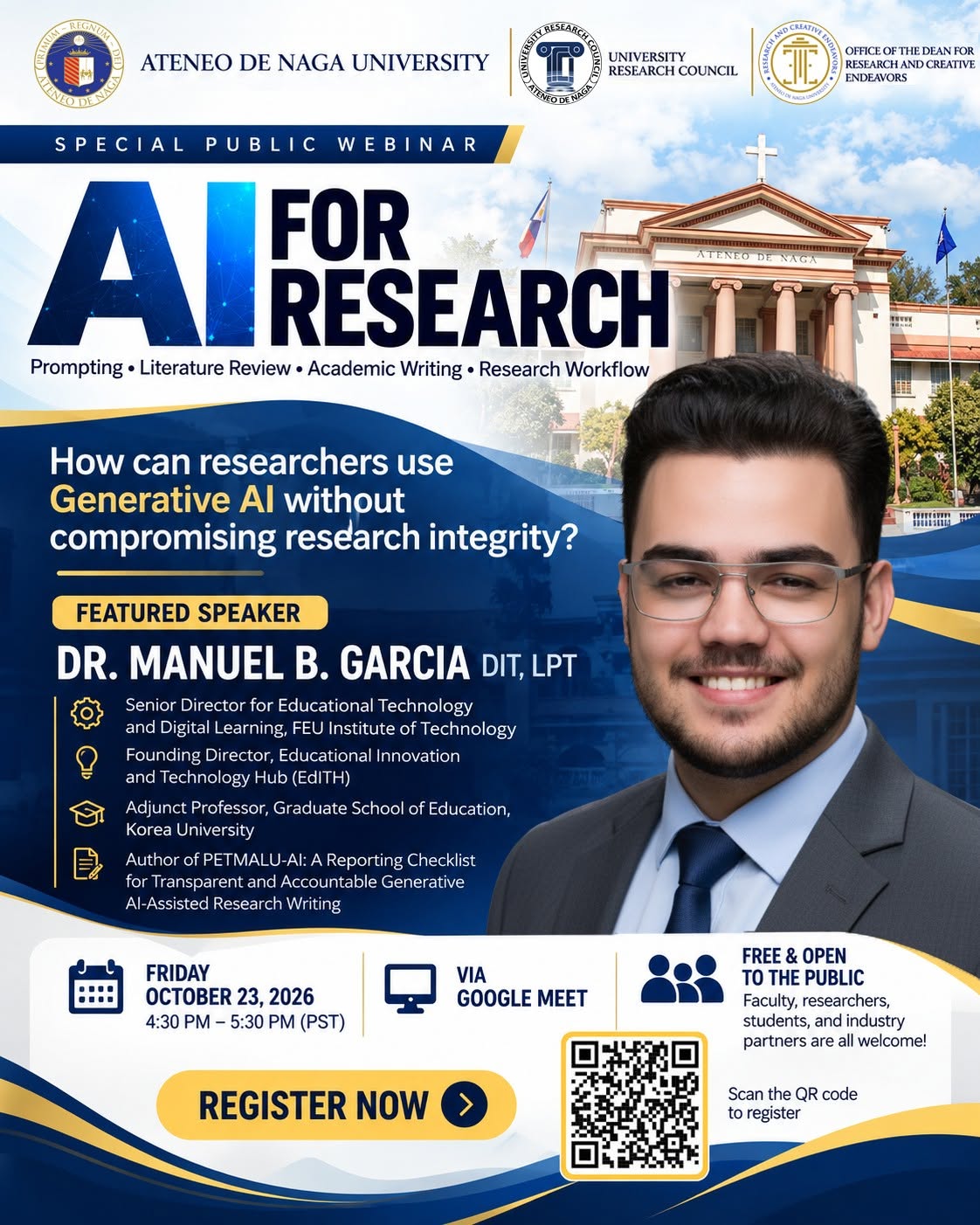
On October 23, 2026, I had the opportunity to explore this question as the featured speaker in a special public webinar organized by Ateneo de Naga University, through its University Research Council and Office of the Dean for Research and Creative Endeavors. The webinar, titled AI for Research: How Can Researchers Use Generative AI Without Compromising Research Integrity?, brought together faculty members, researchers, students, and other participants interested in understanding the responsible use of AI in academic work.
From Research Assistance to Research Responsibility
I began the presentation by revisiting something that many researchers might remember rather fondly, or perhaps not so fondly: doing academic work before generative AI became widely available.
There was the Dark Ages of Writing, when staring at a blank document for 45 minutes sometimes resulted in writing the word "The" and then deleting it. There was also the Google Search Olympics, where finding an answer to a seemingly simple research question could require opening 17 browser tabs. And, of course, the Academic Treasure Hunt, which involved downloading and reading 47 research papers just to produce one reasonably defensible paragraph.
Researchers who have experienced these situations probably know that the numbers are not always exaggerated. Sometimes, 47 papers are just the beginning.
These examples were meant to illustrate an important distinction. Before generative AI, researchers already had access to enormous amounts of information through search engines, scholarly databases, and online learning resources. What generative AI introduced was the ability to generate content on demand, often in response to conversational instructions.
However, the ability to produce an answer does not necessarily mean that the answer is accurate, appropriately supported, or suitable for scholarly use. This is where research responsibility becomes particularly important.

Trusting AI Is Not the Same as Being Trustworthy
One of the central discussions during the webinar concerned the relationship between trust and research integrity. Researchers may trust an AI system because it produces coherent explanations, responds quickly, or appears knowledgeable about a particular subject. Yet these characteristics do not necessarily establish that its outputs are reliable.
In my published study, ChatGPT as an Academic Writing Tool: Factors Influencing Researchers' Intention to Write Manuscripts Using Generative Artificial Intelligence, I examined factors associated with researchers' intentions to use generative AI for academic writing. The findings highlighted the importance of trusting beliefs and task–technology fit, suggesting that perceived usefulness and ease of use alone may not adequately explain researchers' intentions to adopt these tools.
However, trusting a technology enough to use it is different from establishing that the research produced with its assistance is trustworthy.
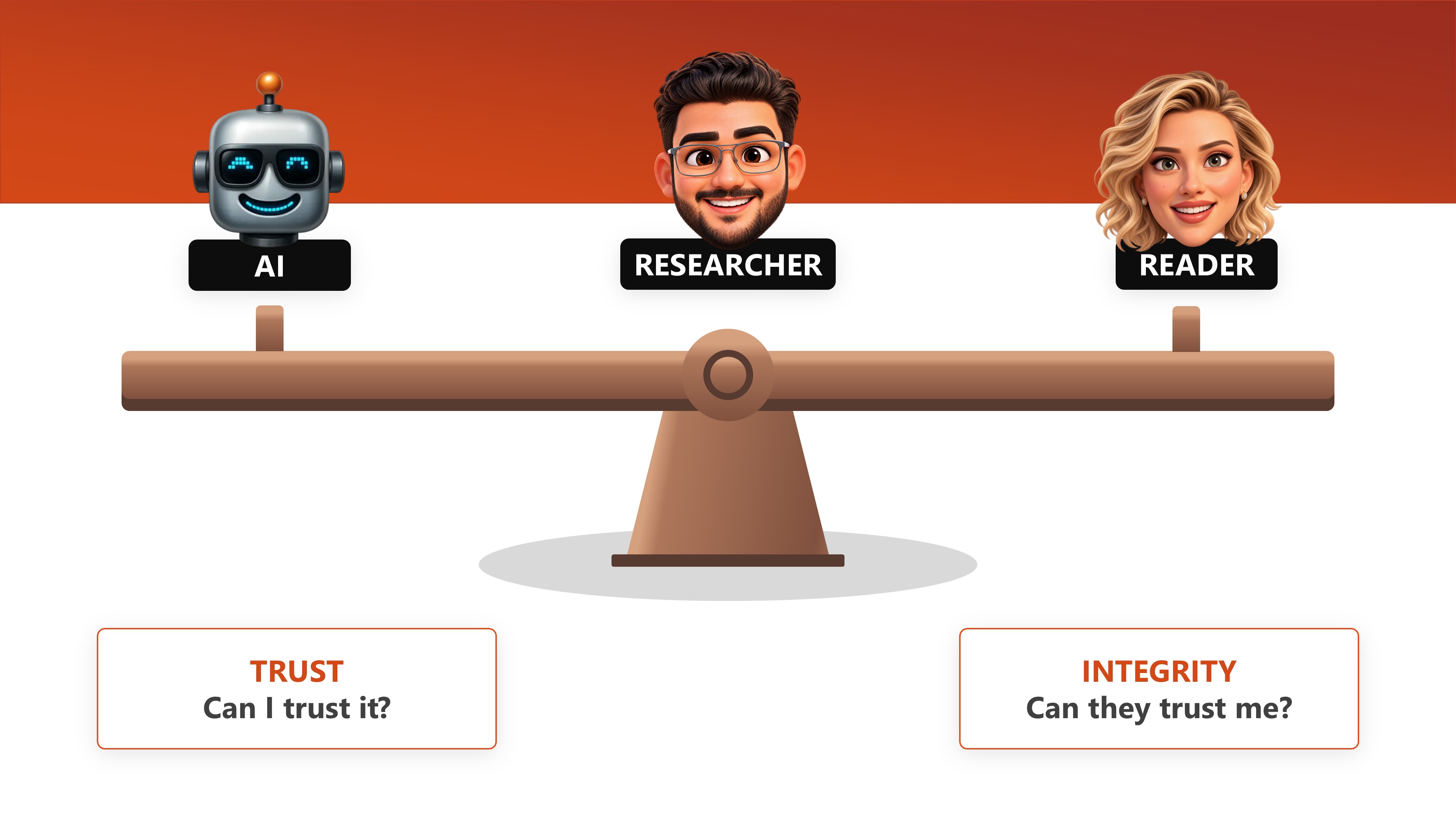
To illustrate this distinction, I presented a researcher positioned between an AI system and a reader. On one side, the researcher asks the AI, "Can I trust it?" On the other side, the reader effectively asks the researcher, "Can they trust me?"
Although these questions are related, they represent different responsibilities. The first concerns the researcher's confidence in a technological system. The second concerns the credibility of the scholarly work that the researcher eventually communicates to others.
This distinction matters because generative AI can produce convincing but incorrect information. During the presentation, I discussed several risks, including citation hallucination, where AI generates nonexistent or inaccurate references; evidence laundering, where a source is presented as supporting a claim it does not actually establish; and sycophantic agreement, where an AI system reinforces a researcher's assumptions rather than critically examining them.
These concerns are not entirely new. In our book, Pitfalls of AI Integration in Education: Skill Obsolescence, Misuse, and Bias, I discussed some of the risks associated with integrating artificial intelligence into educational environments. Although AI technologies and their applications continue to evolve, questions about misuse, bias, and human judgment remain relevant to responsible adoption.
These problems may be difficult to recognize precisely because AI-generated explanations often sound polished and authoritative. A well-written paragraph can still contain a poorly supported argument. Academic vocabulary, unfortunately, is not a substitute for evidence.
I also connected these concerns to the fundamental principles of research integrity identified in the European Code of Conduct for Research Integrity: reliability, honesty, respect, and accountability. These principles remain relevant regardless of whether research is conducted entirely by humans or with the assistance of AI technologies.
AI Can Do More, but Researchers Remain Accountable
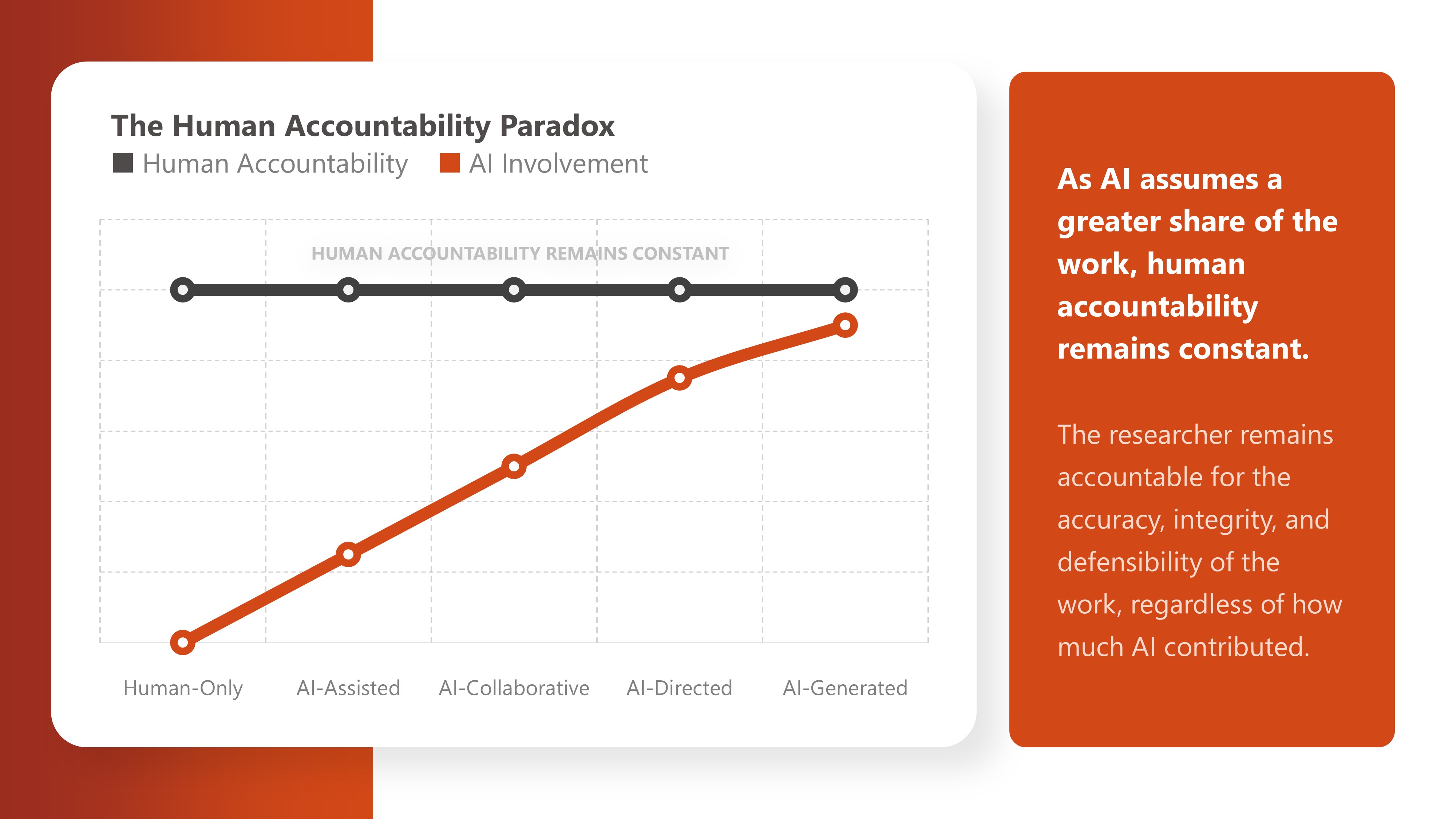
Perhaps one of the most important ideas I shared during the webinar was what I described in the presentation as the Human Accountability Paradox.
Consider a researcher who uses AI only to correct grammar. Now consider another researcher who uses AI to organize literature, generate code, assist with analysis, and draft portions of a manuscript. The extent of AI involvement is considerably different, but the responsibility for the accuracy and integrity of the resulting research does not simply transfer to the technology.
As AI assumes a greater share of research-related tasks, human accountability remains constant.
In practical terms, researchers remain responsible for verifying references, examining whether interpretations are supported by data, identifying potential biases, and determining whether AI-generated material should be accepted, revised, or rejected.
For example, suppose an AI system produces a literature review containing 20 references. If several of those references do not exist, the researcher cannot reasonably defend the manuscript by explaining that ChatGPT generated them. The researcher is still expected to verify the sources before incorporating them into scholarly work.
The same principle applies to statistical interpretations, methodological recommendations, and conclusions. AI may assist with these tasks, but the researcher must retain sufficient understanding and control to explain and defend the decisions made.
This is why I emphasized the difference between an AI-dependent researcher and an AI-accountable researcher. The former may accept AI-generated answers without adequate scrutiny, while the latter critically evaluates those answers, verifies their evidentiary basis, and retains responsibility for consequential research decisions.
Making AI Use Transparent and Accountable
Another important part of the discussion focused on transparency in AI-assisted academic writing.
Research institutions and scholarly publishers have increasingly developed policies concerning the use and disclosure of generative AI. During the webinar, I discussed relevant provisions of the Commission on Higher Education's AI policy framework, alongside guidance from major academic publishers concerning AI-assisted manuscript preparation.
However, an important question remains: Is declaring that AI was used enough to establish transparency?
For example, an author might write, "ChatGPT was used during the preparation of this manuscript." Although this statement acknowledges AI involvement, it leaves several questions unanswered. Which parts of the manuscript were affected? What tasks did the system perform? How were its outputs evaluated? Did the AI merely correct grammar, or did it influence the interpretation of research findings?
These distinctions matter because not all forms of AI assistance carry the same methodological or ethical implications.
This concern also informed my work on PETMALU-AI, or the Principles for Ensuring Transparency in Machine-assisted Authorship, Logging, and Use of Artificial Intelligence, a reporting checklist designed to support transparent and accountable generative AI-assisted research writing.
The framework comprises 33 reporting items organized into nine domains, addressing such matters as disclosure, human accountability, AI system transparency, prompting and interaction processes, validation, ethics, and reproducibility.
During the presentation, I explained how reporting expectations may be proportionate to the nature and extent of AI involvement. Using AI to correct spelling may warrant less extensive documentation than using it to generate analytical code, synthesize evidence, or substantially transform research content.
The underlying principle is relatively straightforward: researchers should be able to explain not only that AI was used, but also how it contributed to the research and what safeguards were applied to its outputs.
Researchers interested in exploring the checklist, its reporting domains, and implementation resources may visit the PETMALU-AI companion website. The framework is also discussed in my published article, PETMALU-AI: A Reporting Checklist for Transparent and Accountable Generative AI-Assisted Research Writing, which provides a more detailed discussion of its reporting principles and proposed applications.
A Meaningful Exchange with the Ateneo de Naga Research Community
Beyond the presentation itself, I appreciated the opportunity to engage with the Ateneo de Naga University research community on a topic that continues to raise important questions for academic institutions, journal editors, and researchers alike.
Opportunities to exchange ideas with fellow researchers have always been an important part of my academic journey. I have previously reflected on the value of scholarly conversations in Research, Wesearch: My Address as Keynote Speaker at the 3rd International Multidisciplinary Research Conference. Although the circumstances and topics of these engagements differ, they share an important purpose: creating opportunities for researchers to reflect on how academic knowledge is produced, communicated, and improved.
I am grateful to Ateneo de Naga University, particularly its University Research Council and Office of the Dean for Research and Creative Endeavors, for the invitation and for organizing the webinar. My appreciation also goes to the faculty members, researchers, students, and other participants who joined the session and contributed to the occasion.
It was encouraging to see the interest in responsible AI-assisted research and the thoughtful acknowledgment shared by participants toward the end of the program. I also sincerely appreciate the certificate of appreciation presented by the organizers.

As generative AI continues to develop, researchers will likely encounter increasingly sophisticated tools capable of assisting with different stages of scholarly work. These developments may improve research efficiency, but they also require careful consideration of the responsibilities that remain with human authors.
I ended the presentation with a reminder that I believe captures the central message of our discussion:
Let AI generate, but you validate. Let AI suggest, but you assess. Because when the research carries your name, the responsibility remains the same.
After all, AI may help us finish a manuscript faster. But when reviewers start asking difficult questions, we still have to provide the answers.